Ganja and Hess
As far as I can tell, a lot of us seem to be lost in the wonder and ambiguity that Ganja and Hess graces upon its audiences. And as much as I want to be an intellectual, I am right there with ya. There is so much going on in here!! Honestly, I find it almost overwhelming to blog about and maybe that is why I have put this off for so many days. Each scene is rich with symbolism, aesthetic, and technique that trying to say anything about the whole film feels like a challenge, at least to say anything original that Benshoff hadn't already noted. What we are dealing with is all of the complexities of blaxploitation, horror, and an art house film that attempts to questions the rules of both of those genres. So as I said, there is a lot going on.
 There was a distinct use in red (often blood), green (emphasis on nature), and shadows (a central theme in the film and vampire films in general)
Firstly, I would like to say that this movie was GORGEOUS. I am currently covering the Black Arts Movement in African American art, and I know Ganja and Hess reaches a bit beyond that period, but it is super interesting to see the crossover in color palettes and other visual signifiers.
SPeaKinG of shadows! Can I talk about that for a second? If you read my post on Nosferatu, you would know that I connected some points about shadows/visibility with vampirism and queerness. Now stick with me here, but I think a similar line can be drawn here. While Ganja and Hess didn't have a particular high number of specific shadows on screen, at least half, if not two-thirds of the film was shot using low key lighting techniques which emphasized the darkness and shadows in any particular frame. Now I know that this film lacked a lot of queer references, (surprisingly because its about vampires...maybe due to the anti-queer/patriarchal sentiments in the black community especially in the 70s) but being a blaxploitation film, race acts in its place.
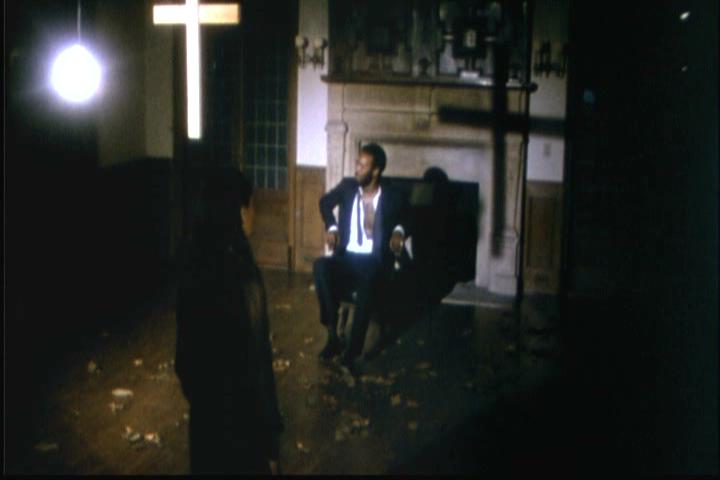
Instead of the visibility of queer identification, Ganja and Hess raises questions about the visibility and/or hyper-visibility of black Americans as the other. This, as Benshoff claimed, is complicated by the intersection of class; and maybe unnoticed by Benshoff, gender. The scene in which Ganja reveals how her mother saw her as a disease has intense low-key lighting, making Ganja's face the subject of a black background. Her mother had marked her as a metaphoric "other" for her perceived sexual deviance. Through her confession she is almost swallowed by the shadows around her. In a more obvious portrayal of shadows, Hess awaits his destruction by the arrival of the cross's shadow on his heart. Revealing of this scene and other's, Hess had been reading "guide to our destruction" where he quoted it saying, "...nothing can survive in the shadows." As a marginalized other, Hess has been living in the shadows his whole life, his strife invisible to his oppressors. The same goes for Ganja, who, as a black woman and now vampire, has been forced to live a life "in the shadows". Now their class as educated elite complicates this more, which leads to questions about their perceived struggle to others like them.
Hopefully that made sense. I am kinda at my wit's end here in quarantine, so if none of that made sense, I apologize.
Firstly, I would like to say that this movie was GORGEOUS. I am currently covering the Black Arts Movement in African American art, and I know Ganja and Hess reaches a bit beyond that period, but it is super interesting to see the crossover in color palettes and other visual signifiers.
SPeaKinG of shadows! Can I talk about that for a second? If you read my post on Nosferatu, you would know that I connected some points about shadows/visibility with vampirism and queerness. Now stick with me here, but I think a similar line can be drawn here. While Ganja and Hess didn't have a particular high number of specific shadows on screen, at least half, if not two-thirds of the film was shot using low key lighting techniques which emphasized the darkness and shadows in any particular frame. Now I know that this film lacked a lot of queer references, (surprisingly because its about vampires...maybe due to the anti-queer/patriarchal sentiments in the black community especially in the 70s) but being a blaxploitation film, race acts in its place.
Instead of the visibility of queer identification, Ganja and Hess raises questions about the visibility and/or hyper-visibility of black Americans as the other. This, as Benshoff claimed, is complicated by the intersection of class; and maybe unnoticed by Benshoff, gender. The scene in which Ganja reveals how her mother saw her as a disease has intense low-key lighting, making Ganja's face the subject of a black background. Her mother had marked her as a metaphoric "other" for her perceived sexual deviance. Through her confession she is almost swallowed by the shadows around her. In a more obvious portrayal of shadows, Hess awaits his destruction by the arrival of the cross's shadow on his heart. Revealing of this scene and other's, Hess had been reading "guide to our destruction" where he quoted it saying, "...nothing can survive in the shadows." As a marginalized other, Hess has been living in the shadows his whole life, his strife invisible to his oppressors. The same goes for Ganja, who, as a black woman and now vampire, has been forced to live a life "in the shadows". Now their class as educated elite complicates this more, which leads to questions about their perceived struggle to others like them.
Hopefully that made sense. I am kinda at my wit's end here in quarantine, so if none of that made sense, I apologize.


Comments
Post a Comment